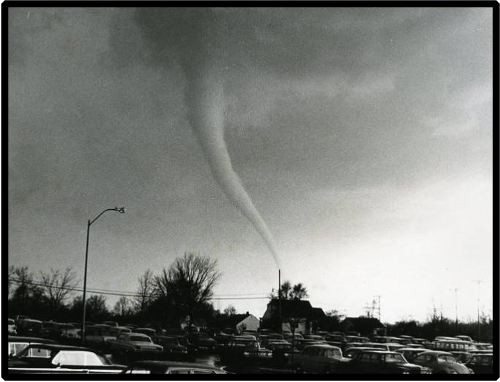
Photo: by Doug Fisher, Shawnee Mission West student, taken from outside the school.
Tuesday, April 19, 1966, started as routinely as any other day. Many locals were discussing how “The Sound Of Music” won the Oscar for Best Picture the night before. The forecast called for a partly cloudy day with a high temperature of 65 degrees and a chance of rain in the afternoon and evening. Around 3 p.m. many mothers in the newly developed Woodstock residential subdivision near 95th & Knox Drive were preparing for their children to come home from the nearby Katherine Carpenter Elementary School, one of the newer schools in the Valley View School District.
By 3:00 p.m. dark clouds had formed to the southwest and could be seen as far away as downtown Kansas City. The local weather bureau had already been following this development, after a series of small funnel clouds had been reported dropping out of the skies further south of Overland Park. By 3:15 p.m., the bureau made the decision to issue a tornado alert to local radio and television stations.
Meanwhile, students at Katherine Carpenter Elementary had just been released for the day. The children were in the process of exiting the building to either walk home or head toward their assigned school bus, when several adults at the school observed a distinct white colored funnel cloud dropping from the darkened sky and appearing to head directly toward them. It was a confusing and tense situation because the civil defense sirens were not sounding, and yet the funnel was clearly visible and appeared to be gaining strength.
Third grade teacher Mary Hatfield was tidying up her classroom when suddenly several of her students ran back into the room with the shocking announcement that a large white funnel was approaching the school and that all students had been ushered back inside the building. Then the sound of the increasing winds could be heard. Mrs. Hatfield and other teachers huddled the children into corners of classrooms and quickly instructed them to bend over and put their hands over their heads. Some students began to cry, while others began to pray.
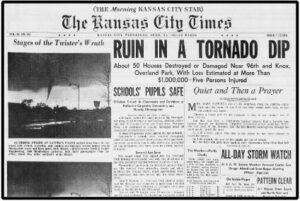
Dick Mason, a draftsman for Black & Veatch, spotted the funnel cloud from his office at Meadowlake & State Line Road. He quickly grabbed his still camera and snapped photos that would appear in the morning edition of the Kansas City Times newspaper. At this same time, Overland Park resident Jim Rollins was in his back yard near 98th & Metcalf when he saw the funnel descending a mile and a half to the west. Thinking quickly, Jim grabbed his 8mm home movie camera and managed to capture film footage of the funnel as it touched down and officially became a tornado. Still, no sound of sirens.
The tornado had touched down just south of the school near 96th Terrace and Knox Drive and immediately began to wreak havoc and destruction in the Woodstock subdivision. Mothers took shelter in their basements and prayed that their children would be safe at the school. Husbands and fathers working downtown helplessly watched and worried as the tornado made its way through their suburb to the southwest, fearful of its path and whether their families would be spared.
Upon touching down, the white funnel quickly turned black as it picked up debris along its northeasterly path down 96th Street. Roof shingles, lumber, insulation and sheetrock exploded and became airborne. At Katherine Carpenter school, windows began to shatter blow out as the roar of the tornado could be heard passing just to the south.
And less than a minute later, the tornado lifted back up into the clouds as the storm proceeded to the northeast. There was an eerie moment of silence, broken only by the sound of airborne objects hitting the ground. And then, finally, the wailing sound of a nearby civil defense siren. Teachers and students waited for the all-clear and confirmation that the danger had passed. Parents then scrambled to the school in cars and on foot in hopes of being reunited safely with their children.
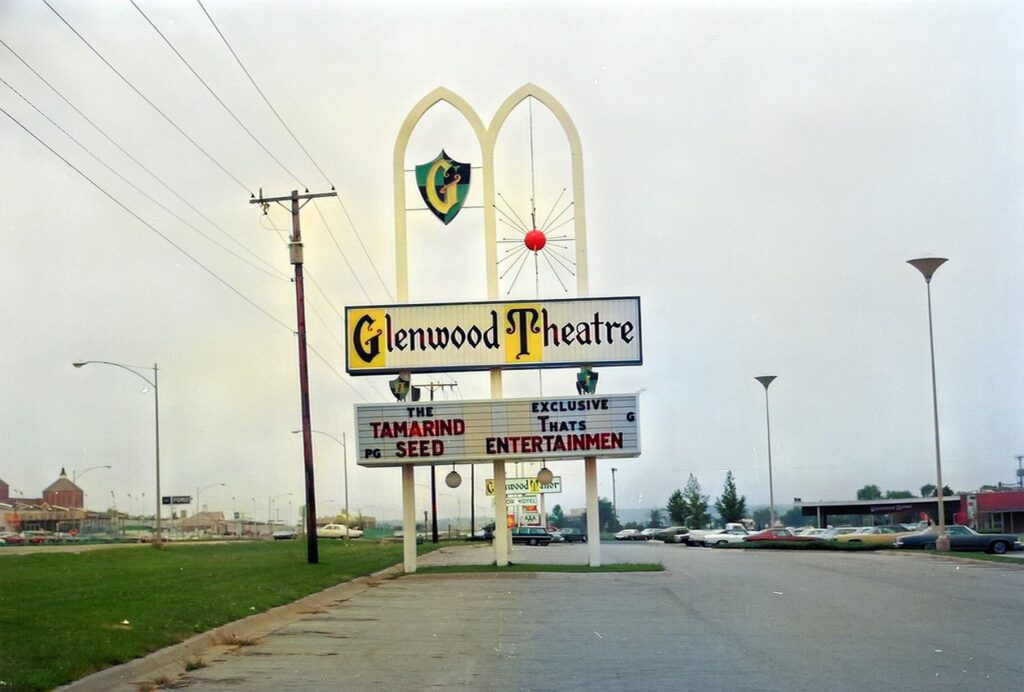
Within 30 minutes, police, fire and emergency services raced to the scene to assist those in need. Joe Ross, the manager of the nearby Glenwood Manor Motor Hotel, was one of the first civilians on the scene. Joe accompanied Overland Park Police Chief John Kenyon, going door-to-door to check on the welfare of residents impacted by the tornado. Surveying the incredible damage affecting four neighborhood streets, Joe Ross coordinated with the Red Cross and offered free rooms at the Glenwood Manor to anyone who had been displaced by the disaster.
In total, 50 homes in the Woodstock subdivision had been either significantly damaged or destroyed. Miraculously, there were no fatalities, and only five residents who required treatment at Shawnee Mission Hospital. Damage to the school was mostly limited to windows and portions of the roof, but the damage was severe enough that the school had to close for the remainder of the school year, with the students transferred temporarily to the Valley View Elementary School while repairs were made.
News coverage of the destruction led all evening newscasts. In the days following the incident, many eyewitness accounts were recorded and documented. Overland Park Mayor, Marvin Rainey, expressed concern over the fact that the civil defense sirens were not activated until AFTER the storm had passed. Ten minutes of advanced warning were lost, and significant changes to the procedures and protocols for siren activation were changed because of this incident.
Sixty years later, there are no lasting traces of that frightening April afternoon. Some residents impacted by the tornado still live in their same homes today and have shared their story over the years with new neighbors. To this day, the tornado of April 19, 1966, holds the record as the most destructive tornado event in the city’s history since incorporation.
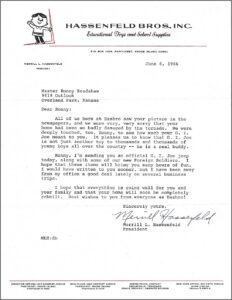
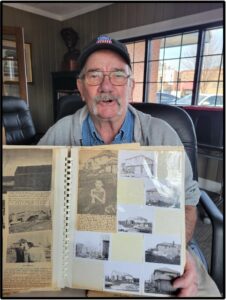 Ron Bradshaw donated his family’s scrapbook about the tornado to Discover O.P. Ron, who now lives in Springfield, Missouri, recounted the afternoon and the impact it had on the family on his visit. (That’s Ron in the newspaper article shown on the scrapbook page. He’s clutching his G.I. Joe action figure. In response to the photo, Merrill Hassenfield, President of Hassenfeld Brothers, Inc., (better known as Hasbro) sent young Ron a G.I. Joe Jeep and “new foreign soldiers.”